


The Ultimate SEO Strategy for E-Commerce Website to Fix Your Online Store Rankings! 2026
 Mansi Jethudi
Summarize this blog post with:
Overview
E-commerce SEO is the foundation of long-term online store growth. This guide covers everything from keyword research, site architecture, product page optimization, technical SEO, content marketing, and schema markup to fixing duplicate content issues.
By implementing these strategies, online stores can improve search visibility, attract high-intent buyers, increase organic traffic, and generate sustainable revenue without relying solely on paid advertising.
Introduction
When it comes to e-commerce, visibility is everything. You can have the most beautiful website, fastest checkout, and killer product photos — but if people can’t find you on Google, your business is practically invisible.
In 2026, SEO isn’t just a marketing tactic. It’s your digital shelf space in a crowded marketplace.
Let’s look at some recent stats:
- 43% of E-commerce Traffic Comes from Organic Google Search — source: Shift4Shop
- 68% of Online Experiences Begin with a Search Engine — source: Intergrowth
- Organic Search Drives 40.2% of E-commerce Revenue — source: Opensend
SEO strategy for e-commerce sites is about three key pillars: solid technical foundation, well-optimized content, and a delightful user experience.
Let’s break it all down in a conversational format so it’s easier to digest, whether you’re a solo store owner, e-commerce manager, or marketer.
What is E-commerce SEO Strategy, and How is it Different from Regular SEO?
E-commerce SEO is the art and science of getting your product and category pages to rank in search engines like Google, Bing, and even YouTube or Pinterest.
Unlike traditional websites, where you optimize for a few service pages or blogs, e-commerce sites have:
- Hundreds (or thousands) of product URLs
- Faceted navigation (filters, categories, variants)
- Technical challenges like duplicate content and crawl budget issues
So, SEO strategy for e-commerce sites means optimizing site architecture, product metadata, image SEO, schema markup, and even product reviews to rank organically for buying-intent keywords.
What Are the Benefits of an SEO Strategy for E-commerce Websites?
Investing in SEO isn’t just about ranking higher — it’s about building a sustainable online business. Here’s why smart brands focus heavily on e-commerce SEO services:
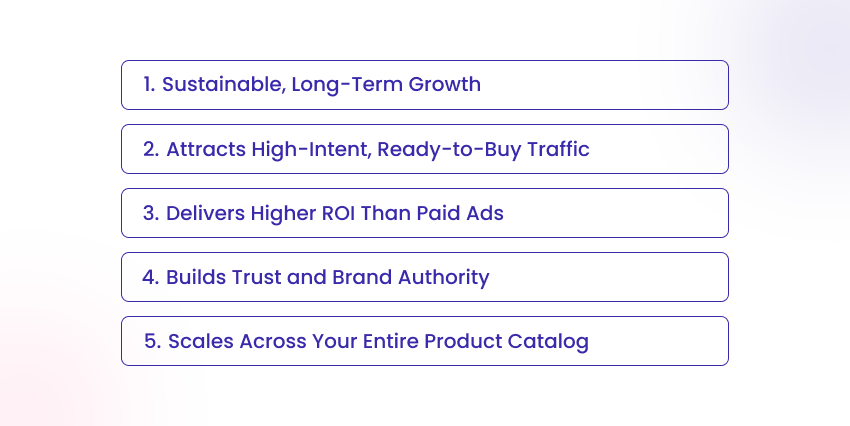
1. Sustainable, Long-Term Growth
Unlike paid ads that stop bringing traffic once you pause spending, SEO builds a foundation that keeps working for you 24/7. A well-optimized page can attract traffic for months or even years, without ongoing ad budgets.
2. Attracts High-Intent, Ready-to-Buy Traffic
Another benefit of e-commerce SEO is that it helps you reach people who are actively searching for what you sell. Someone Googling “buy vegan leather laptop bag” isn’t window-shopping — they’re ready to pull the trigger. That kind of traffic is gold.
3. Delivers Higher ROI Than Paid Ads
While ads can drive fast results, they get expensive and competitive. Organic search traffic costs nothing per click, and the ROI improves over time as your rankings and domain authority grow. Once you rank, each sale becomes cheaper.
SEO strategy for e-commerce websites offers an average ROI of 317% — Exploding Topics
4. Builds Trust and Brand Authority
Users trust Google, and when your store shows up organically, that trust rubs off on your customers. Ranking high for key terms establishes your brand as a leader in your category, even before customers land on your site.
5. Scales Across Your Entire Product Catalog
The beauty of SEO? Improvements to your structure, speed, or content don’t just affect one product — they lift your entire site. The more you grow, the more your SEO engine works in your favor.
Partner with Enstacked Technologies, your trusted E-Commerce Development Company, to build SEO-optimized, high-converting online stores.
Hire Dedicated Shopify Developer
Where Should I Start if I’m Building an SEO Strategy for E-commerce Sites from Scratch?
Start with the foundation. Here’s your E-commerce Ultimate Shopify SEO Checklist:
1. E-commerce Keyword Research
Your first task is to find what your customers are searching for. Go beyond generic terms. Use long-tail keywords like “Best noise-cancelling headphones under $200” or “Organic cotton baby clothes USA.”
Pro Tip
Look at your internal search bar data — what users type there is gold for keyword ideas.
Use tools like: Ahrefs, Semrush, Google Keyword Planner, Ubersuggest, and AnswerThePublic.
| Keyword Type | Examples | Purpose |
|---|---|---|
| Category-Level Keywords | Women’s Sneakers, Men’s Running Shoes, Waterproof Hiking Boots | To rank main category pages and target high-volume shopping intents |
| Product-Level Keywords | Nike Air Max 2024 White, Adidas Ultraboost Size 10, Puma Suede Blue Sneakers | To optimize product detail pages for long-tail, high-conversion searches |
| Informational Keywords | How to clean white sneakers, Best shoes for plantar fasciitis, What are the most comfortable walking shoes? | To build blog content, drive top-of-funnel traffic, and build authority |
2. E-commerce URL Site Architecture
Keep it simple, logical, and crawlable. Recommended hierarchy:

For example:
✅ example.com/women/sneakers/white-nike-airmax
❌ example.com/product?id=2345&catid=8&type=shoes
A flat site structure (most pages are 2–3 clicks from homepage) helps search engines crawl your site faster.
- Ensure internal linking connects product pages to category and blog content
- Avoid orphan pages — pages with no internal links pointing to them
Pro Tip
Use breadcrumbs (e.g., Home > Men > Shoes > Oxford) to improve UX and pass internal link equity.
3. On-Page SEO for E-commerce Product Pages
Make sure every product page has:
- Keyword in page title
- Unique meta description
- Optimized H1 heading
- Product description with long-tail keywords
- Alt text for images
- FAQ or Q&A section (use FAQ schema)
- Product schema
What About Duplicate Content Issues in E-commerce?
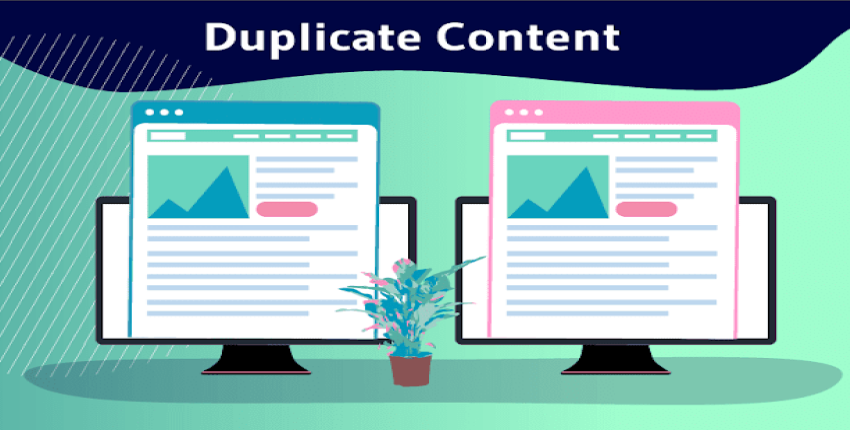
E-commerce sites often face duplicate content because of product variants (size, color), parameter-based URLs from filters, and manufacturer-supplied product descriptions.
Fixes:
- Use canonical tags to point to the main version of a page
- Customize product descriptions (never copy-paste manufacturer text)
- Block faceted URLs from being crawled via robots.txt or nofollow
Pro Tip
Use dynamic content blocks to auto-insert variant-specific descriptions (e.g., different colors or materials) at scale.
Should I Focus on Category Pages Too?
Absolutely! Category pages often rank better for broad keywords (e.g., “running shoes” vs. “Nike Air Zoom Pegasus 40”).
Optimize them by:
- Writing introductory SEO-friendly text
- Adding internal links to top products
- Using H2s, bullet points, and filters that are crawlable
- Implementing product review schema, if applicable
Handling Seasonal & Out-of-Stock Pages:
- Seasonal products (like holiday gifts): Don’t delete; optimize year-round and update seasonally.
- Out-of-stock items: Add related product suggestions, keep the page indexed, or 301 redirect if discontinued.
Use structured data to indicate stock status for better SERP display.
How Important is Technical SEO for an E-commerce Website?
It’s critical. Google won’t rank your site if it can’t crawl, index, or understand it.
Top technical must-haves:
- Fast loading speed (PageSpeed Insights)
- Mobile-friendliness (use responsive design)
- XML sitemap for products and categories
- SSL certificate (HTTPS)
- Fix crawl errors in Google Search Console
Use tools like: Screaming Frog, Sitebulb, and Lighthouse.
Pro Tip
Use Google Search Console’s “Pages Indexing” section regularly to fix indexing issues fast.
Ecoms are notorious for creating multiple URLs due to sorting, filters, etc. Leads to a lot of duplicate pages that are essentially competing against each other. Make sure you specify the canonical and also consider doing rel=noindex for dupe pages.
Can Content Marketing Help an E-commerce Store Rank Better?
Yes — more than ever. Content helps you target informational and long-tail queries, build internal links to product pages, earn backlinks to your domain, and improve dwell time and authority.
Examples of content:
- “Top 10 Hiking Boots in 2026”
- “How to choose the perfect wedding dress”
- “Gift guide: Best skincare sets under $100”
Action Step & Pro Tip
Create one blog post every 2 weeks that links internally to at least 3 product pages. Use tools like AlsoAsked.com to find questions people actually ask related to your product line.
What About Product Reviews and User-Generated Content?
User-generated content (UGC) is SEO gold.

Why?
- It provides fresh content for Google to crawl
- Adds long-tail keywords naturally
- Increases conversion rates by building trust
Make sure reviews:
- Are crawlable (not hidden in tabs or loaded via JS)
- Include Review schema markup
How Do I Track My E-commerce SEO Performance?
Set up the following:
- Google Analytics 4 (GA4): To track traffic and sales
- Pretty Insights — a real-time data analytics tool that delivers live website insights, completely cookie-free
- Google Search Console: For keyword rankings and crawl issues
- Rank tracking tools: Like Ahrefs, Semrush, or SE Ranking
Use annotations in GSC and GA4 when you make major SEO changes, so you can correlate with traffic shifts later.
Track metrics like:
- Organic traffic (vs. total traffic)
- Conversion rate from organic visitors
- Revenue by channel
- Top-performing landing pages
- Keyword movement (rank gains/losses)
How Long Will It Take to See Results After Implementing SEO Strategy for E-commerce Websites?
SEO isn’t instant. Expect:
- 3–6 months to see meaningful traffic improvements
- 6–12 months for consistent ROI, especially in competitive niches
Factors that affect this: site age and domain authority, number of indexed pages, competition in your niche, and content frequency and quality.
Pro Tip
Don’t chase only volume. 100 visitors with buying intent > 10,000 casual browsers. Focus on doing the basics well: fast site, clear navigation, strong content, and solid keyword research. Don’t overcomplicate it — Google rewards consistency over tricks.
What Are the Best E-commerce SEO Examples?
| Brand | Why It’s Great | Key SEO Tactic |
|---|---|---|
| Amazon | Ranks for millions of keywords through SEO-optimized product pages with rich content, customer reviews, structured data, and schema markup | Long-tail keyword targeting + internal linking |
| ASOS | Excellent site structure, lightning-fast load times, mobile-first design, and strong use of canonical tags and international SEO strategies | Optimized category pages + clean URLs |
| Etsy | Leverages user-generated content on product pages and ranks well for niche, long-tail keywords | Scalable UGC-driven SEO |
What Are the Challenges of E-commerce SEO?
SEO strategy for e-commerce websites can be particularly challenging due to the scale and dynamic nature of product-based websites. Here are the most common roadblocks:
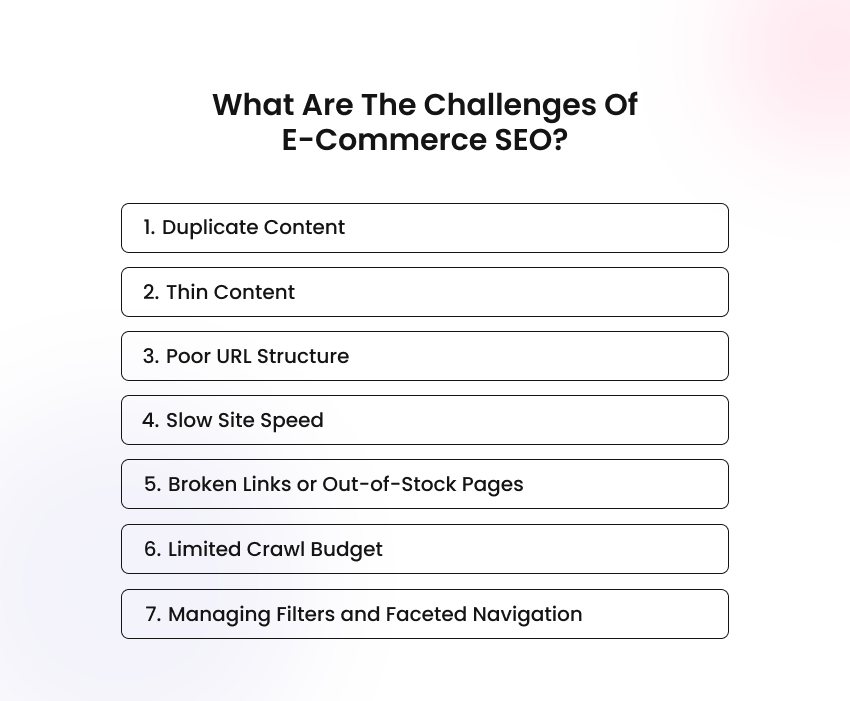
- Duplicate Content: With thousands of products or variations, pages often share similar titles or descriptions, which hurts rankings.
- Thin Content: Many product pages have minimal text or only generic descriptions, making it hard for search engines to understand their value.
- Poor URL Structure: Improper use of parameters, filters, or dynamic URLs can lead to crawl inefficiencies and indexing issues.
- Slow Site Speed: Image-heavy pages, poor coding practices, or unoptimized plugins can degrade performance, especially on mobile.
- Broken Links or Out-of-Stock Pages: Frequent inventory changes can lead to 404 errors if not handled properly with redirects or soft 404 handling.
- Limited Crawl Budget: If you have thousands of products, Googlebot might not crawl all pages effectively, leading to missed indexing opportunities.
- Managing Filters and Faceted Navigation: Faceted navigation (filtering by size, color, price, etc.) can lead to a large number of duplicate or thin pages if not properly handled with canonical tags or noindex directives.
Also Read
Final Thoughts
SEO is the long game, but it’s worth every bit of effort.
While paid ads offer short bursts of visibility, SEO builds a reliable, cost-effective customer acquisition engine. And best of all? Your competitors can’t just outbid you for it overnight.
If you start now, optimize consistently, and listen to your customers, Google will follow.
Doing SEO but still not getting the results you expected? Or just want clarity on where your store stands? Book a free SEO audit or hop on a no-obligation consultation call with our experts. We’ll help you uncover missed opportunities and set the right direction — absolutely free.
Frequently Asked Questions (FAQs)
Should I hire an agency for SEO for an e-commerce website?
Yes — hiring Digital marketing agency can save you time, bring proven expertise, and deliver long-term results that are often more cost-effective than trial-and-error in-house efforts. A good SEO agency understands e-commerce intricacies and offers end-to-end e-commerce SEO services — from optimizing product pages to technical SEO and more — helping you scale sustainably.
Does Enstacked provide comprehensive eCommerce SEO services?
Yes, we do. From technical SEO and on-page optimization to keyword research, content strategy, link building, and ongoing performance tracking, we cover every angle to help your store grow sustainably.
What are the benefits of e-commerce SEO services from Enstacked?
Increased organic traffic with buyer intent, higher product visibility across search engines, improved page speed, structure, and mobile experience, strategic content and blog optimization, long-term ROI with measurable results, and transparent reporting with regular growth insights.
Can I hire dedicated marketers from Enstacked who can help me with eCommerce SEO services?
Yes, you can hire SEO marketers from Enstacked for e-commerce SEO services to get tailored strategies, faster execution, and consistent growth for your online store.

- Recover Lost Sales
- Boost Conversions
- Reduce Abandonment
- Faster Store
📘 FREE REPORT
The Shopify Revenue Leaks Report
Discover the hidden mistakes silently costing Shopify stores thousands every month—and learn exactly how to fix them.
Instant access • No spam • Unsubscribe anytime.