



Summarize this blog post with:
Overview
Shopify trends are the emerging technologies, features, and customer shopping behaviors shaping how online stores grow and compete. In 2026, trends such as AI-powered personalization, social commerce, subscription models, voice commerce, augmented reality (AR), omnichannel selling, sustainable shopping, and creator-led marketing are helping merchants improve customer experiences, increase conversions, and scale their businesses.
This guide explores the top Shopify trends and how you can use them to stay ahead of the competition.
Introduction
2026 is set to be a game-changer for businesses. So many Shopify trends are shaping the eCommerce industry and customer experiences this year.
The way customers shop, interact with brands, and make decisions is constantly shifting, and businesses need to adapt to remain competitive. Falling behind could mean missed opportunities, lower sales, and losing customers to more innovative competitors.
Revenue in the eCommerce Market is projected to reach US$4,791 billion in 2025, with a projected market volume of US$6,478 billion by 2029.
Luckily, Shopify makes staying ahead easier than ever. With its flexible platform, robust Shopify features, and seamless integrations, merchants can quickly adapt to trends and ensure their stores remain relevant, efficient, and successful.
Here are the top 8 Shopify trends set to dominate 2026, why they matter, and how you can implement them. Let’s get started!
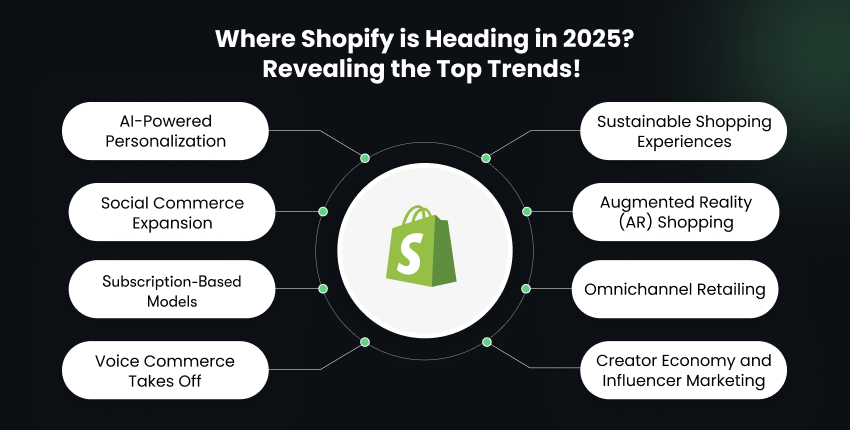
Revealing the 8 Top Shopify Trends for 2026
Here are 8 Shopify trends that Shopify merchants like you need to start using soon to stay ahead in 2026.
1. AI-Powered Personalization
The days of generic online shopping experiences are gone. In 2026, AI-powered personalization is taking center stage, enabling businesses to deliver unique experiences tailored to each customer’s behavior, preferences, and needs.
A Forbes report citing Accenture found that 91% of consumers said they are more likely to do business with brands that recognize and remember them and present them with relevant recommendations and offers.
How does Shopify make it easier?
- AI Tools Integration: Shopify Magic and apps like LimeSpot provide personalized recommendations, custom product suggestions, and dynamic email content.
- Behavioral Insights: Shopify’s analytics helps segment customers based on browsing and purchase behavior.
- Custom Discounts: Automates personalized discounts and upsell offers for returning customers.
- Email Automation: Shopify Email allows businesses to send personalized campaigns effortlessly.
2. Social Commerce Expansion
With platforms like Instagram, TikTok, and Facebook transforming into shopping destinations, social commerce is becoming a key revenue driver in 2026.
According to Hostinger, 82% of consumers use social media for product research, with 55% of Gen Z favoring TikTok and 52% of Millennials preferring Facebook.
How does Shopify make it easier?
- Built-in Social Media Integrations: Sell directly through Instagram, TikTok, Facebook Shops, and Pinterest.
- Shopify Apps: Use apps like Socialshop to curate shoppable content for social media.
- Shoppable Posts: Enable one-click checkouts without leaving the social platform.
- Shopify Analytics: Use Shopify’s analytics to identify the best-performing social channels for your brand.
Choosing the right development partner matters just as much as the platform itself. Read more on why Shopify is the best eCommerce development platform, and look for a developer familiar with Agile, who will be better equipped to handle shifting priorities and collaborate efficiently with your internal team.
3. Subscription-Based Models
The subscription economy continues to thrive as customers prioritize convenience and recurring services over one-time purchases. The subscription market is projected to surpass $500 billion, providing businesses with predictable revenue streams and long-term customer relationships.
How Shopify makes it easier:
- Subscription Apps: Tools like Recharge and Bold Subscriptions allow seamless implementation of recurring billing and flexible subscription options.
- Flexible Plans: Allows merchants to offer multiple subscription tiers and delivery schedules.
- Automated Reminders: Sends renewal alerts to keep customers informed.
- Customer Portal: Offers a self-service portal for customers to manage subscriptions.
Actionable tips: Offer incentives like discounts for subscribers, and use email campaigns to remind customers of upcoming renewals or offer add-ons.
Success Story: Meal kit service HelloFresh built its business on subscriptions, growing into a billion-dollar brand.
4. Voice Commerce Takes Off
Smart speakers like Alexa, Siri, and Google Assistant are becoming integral to the shopping experience, enabling customers to shop hands-free, with enhanced convenience, a better experience, and higher sales.
Voice commerce is reshaping convenience. It’s not just about asking, it’s about acting faster than ever before.
How Shopify makes it easier:
- Voice-Enabled APIs: Shopify integrates with voice assistant tools, enabling easy shopping through commands.
- Voice Integration: Shopify supports integrations with Alexa, Google Assistant, and Siri.
- Voice-Optimized Descriptions: Businesses can seamlessly optimize product descriptions with natural language and long-tail keywords to drive desired results.
- Voice-Activated Commands: Shopify apps enable voice-activated shopping workflows.
- Shopify Flow: Automates voice-driven notifications like shipping updates.
Also Read: Lovable Shopify Integration: Fast AI Store Builder
5. Sustainable Shopping Experiences
As eco-consciousness rises, customers are gravitating towards brands prioritizing sustainability. Sustainable practices have moved from being a “nice-to-have” to a “must-have.”
Nike uses Shopify to support its sustainability initiatives, such as its “Move to Zero” campaign aimed at reducing carbon emissions and waste. By offering eco-friendly products made from recycled materials, Nike strengthens its brand loyalty and drives positive consumer engagement.
How Shopify makes it easier:
- Shopify Planet: Offsets carbon emissions for deliveries and promotes eco-friendly shipping.
- Sustainable Product Tags: Lets businesses label products as eco-friendly.
- Handshake Marketplace: Connects businesses with sustainable and ethical suppliers.
- Custom Packaging Options: Shopify integrates with eco-friendly packaging providers.
- Carbon Tracking: Tracks and displays the carbon impact of orders.
Actionable Tip: Highlight your eco-friendly practices on your Shopify store and integrate them with your social media channels.
6. Augmented Reality (AR) Shopping
AR is transforming the way customers shop online by bridging the gap between virtual and physical shopping experiences.
A consumer AR survey by Google found that 66% of people are interested in using augmented reality technology for help when shopping.
How Shopify makes it easier:
- Shopify AR: Allows merchants to upload 3D models of products for interactive visualization.
- Customizable Widgets: Embeds AR directly into product pages.
- Mobile-Ready Features: Ensures AR is accessible on mobile devices.
- Analytics: Tracks AR engagement to measure ROI.
IKEA, the leading furniture company, uses augmented reality (AR) to enhance its eCommerce experience, allowing customers to visualize furniture in their own homes before purchasing. Through the IKEA Place app, powered by Shopify’s AR tools, users can see how products fit and look in their space, boosting confidence and reducing returns. This innovative approach has improved customer satisfaction and driven higher conversion rates.
Actionable tips: Use AR for furniture, clothing, or beauty products to let customers “try before they buy,” and promote your AR features through targeted ad campaigns.
7. Omnichannel Retailing
Nowadays, consumers purchase on a variety of channels, including websites and online marketplaces, social media, offline stores, etc. Therefore, your organization must have a multi-channel strategy both now and in the future.
However, you must select the appropriate channels to achieve the best results. When selecting a platform, keep your target audience, product type, and competitors in mind. Start with one or two more channels at first, then progressively add more.
- The Shopify Marketplace Connect tool allows you to sync product listings, inventory, and orders between Shopify and prominent marketplaces.
- Shopify’s enhanced expansion tool can help you explore Markets, now facilitating retail, international, and business-to-business (B2B) growth (B2B is available on Plus plans).
- Simplify channel management from a single dashboard.
- Craft captivating product descriptions that are specific to each platform.
- Use Shopify’s inventory management solutions to prevent stockouts and overselling.
- Consistent branding and messaging: Ensure that your branding and messaging are consistent across all platforms.
- Ensure a consistent consumer experience regardless of platform.
- Regularly assess each channel’s performance and modify your approach as necessary.
Take your Shopify store omnichannel. Managing multiple sales channels can feel overwhelming, but with the right Shopify setup, you can simplify everything from marketplaces to social media.
Hire Dedicated Shopify Developers
8. Creator Economy and Influencer Marketing
Creators and influencers are becoming powerful allies for brands, driving traffic and boosting credibility through authentic endorsements. Whether you are building your brand or expanding it, influencer marketing and creators are your best friends. With the help of their community, you can build yours. But make sure to choose the influencers that are relevant to your niche and can ensure targeted marketing. It ensures better brand connectivity and results.
Did you know that 70% of Gen Z trust influencer recommendations over traditional ads?
How Shopify makes it easier:
- Influencer Collaboration Tools: Apps like Carro help identify and collaborate with influencers.
- Affiliate Marketing Programs: Shopify enables easy tracking of influencer-driven sales.
- Discount Codes: Generates custom codes for influencers to track their impact.
- Social Proof Features: Displays influencer testimonials on product pages.
- Influencer Tracking: Tracks sales and performance driven by influencer campaigns.
- Integrated Marketing: Combines influencer promotions with Shopify’s social commerce tools.
Conclusion
As the days move, so do the innovation and growth. The eCommerce landscape is evolving faster than ever, so businesses need to stay ahead and embrace the trends, only the ones that feel right for your business. And Shopify, being every eCommerce business’s best friend, keeps releasing new features.
Its robust tools and integrations empower businesses to innovate, enhance customer experiences, and achieve lasting success.
The Shopify Trends are here, how will you make it yours?
If you need our assistance in making the future better for your business, then our team at Enstacked is just a call away.

- Recover Lost Sales
- Boost Conversions
- Reduce Abandonment
- Faster Store
📘 FREE REPORT
The Shopify Revenue Leaks Report
Discover the hidden mistakes silently costing Shopify stores thousands every month—and learn exactly how to fix them.
Instant access • No spam • Unsubscribe anytime.