


What is Data Tokenization & Why Businesses are Leveraging it for Added Security?
 Ekta Jesani
Summarize this blog post with:
TL;DR
Data tokenization is the process of replacing sensitive information, such as credit card numbers, medical records, or critical business data, with non-sensitive placeholder values called tokens.
The real data is kept in a secure, separate system, so even if tokens are intercepted, they are useless without access to that system. It helps businesses reduce breach risk, meet compliance requirements like PCI DSS and GDPR, and handle sensitive data more safely.
Introduction
Welcome to the fast-moving world of data security and digital transformation. Today we’re unpacking a term that keeps making headlines across these industries: tokenization.
Tokenization has become one of the most important developments in data protection and digital assets in recent years.
Did you know the global tokenization market is projected to reach $5.6 billion in 2026, growing at a compound annual rate of about 19%?
As related technologies continue to reshape how organizations store and move information, tokenization holds real potential to change how we protect our most important data.
But what exactly is data tokenization, and why is it increasingly seen as central to the future of data security? In this post, we’ll cover everything you need to know.
Let’s get started.
What is Data Tokenization?
Data tokenization is the process of turning private information, like credit card numbers, medical records, and critical business data, into tokens that can be safely stored and processed without exposing the original data.
These tokens carry no exploitable value on their own. The real data is held in a secure token vault or system, so a token can be used in everyday workflows while the sensitive value stays protected.
For payment processing, for example, a credit card number can be replaced with a random string of characters, letting a transaction proceed without ever exposing the actual card number.
Tokenization can also apply to things like user account data, allowing platforms to handle personal information while keeping the underlying details private and under the owner’s control.
Although the concept isn’t new, it has long been used to safeguard payment data in the financial industry, and it’s increasingly being adopted across other sectors.
Take the IT industry, for example. A web and mobile app development company can use data tokenization throughout the development process to protect sensitive client information.
The Most Common Use Cases of Data Tokenization
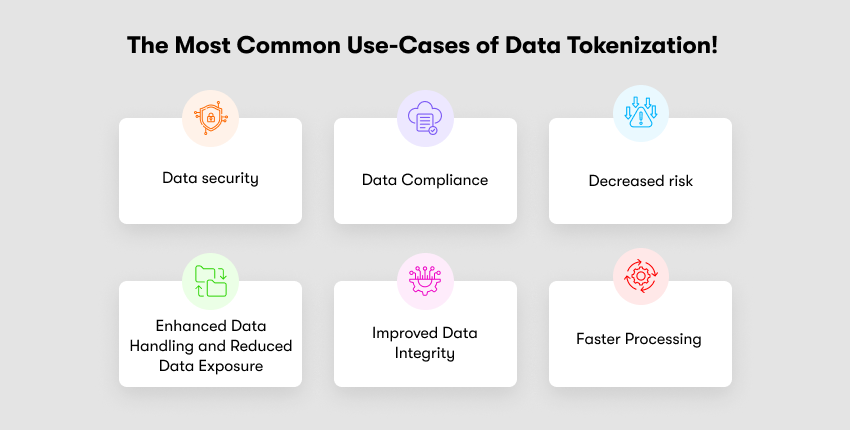
- Data security: Tokenization prevents sensitive data such as credit card numbers, social security numbers, and critical personal or corporate information from being stored or transmitted in its original form. This significantly reduces the likelihood of unauthorized access, data breaches, and sensitive data disclosure.
- Data compliance: For credit card data, tokenization helps businesses comply with the Payment Card Industry Data Security Standard (PCI DSS). By reducing the volume of sensitive data handled and narrowing the scope of compliance audits, tokenization makes compliance management more efficient.
- Reduced risk: Tokenization lowers the risk of transmitting and storing sensitive information. Without access to the tokenization system or database, the tokens are useless, even if they are intercepted or accessed by unauthorized parties.
- Enhanced data handling and reduced exposure: Because businesses no longer need to store sensitive information directly, tokenization reduces the risk of internal or accidental data leaks. Storing tokens instead of raw data simplifies data management while minimizing points of exposure. It also helps control access and enables clearer tracking of data usage across the organization, supporting better governance and oversight.
- Improved data integrity: By using tokens in place of sensitive data, tokenization helps preserve the accuracy and consistency of information across platforms. Tokens help prevent unauthorized modifications, keeping the original data intact and reliable, which is essential for trustworthy decision-making, reporting, and compliance.
- Faster processing: Tokenization reduces the need to repeatedly decrypt sensitive information, which can improve performance in applications that rely heavily on data access. Since tokens are smaller and hold no sensitive value, they can be processed quickly, making tokenization well suited to businesses handling high transaction volumes or data-heavy operations.
Example: How Microsoft Uses Tokenization in Azure
Microsoft is a useful example of tokenization in action at scale. Across its Azure cloud services, Microsoft needs to secure customer data while complying with strict privacy laws like GDPR and CCPA.
Given the sheer scale of Azure, tokenization is one of the techniques used to minimize sensitive data exposure across applications and regions.
This approach helps protect personal information, financial details, and other high-risk data across the Azure ecosystem.
When tokenization is applied, a breach or unauthorized access would reveal only tokens, which are useless without the secure environment that generated them.
How it helps:
- Enhanced data security: By keeping sensitive data out of general-purpose applications, tokenization reduces the risk and impact of data breaches.
- Compliance with privacy laws: Tokenization supports compliance with frameworks like GDPR, HIPAA, and CCPA, reassuring clients and users that their data is handled securely.
- Improved customer trust: A strong tokenization strategy reassures clients that their sensitive data stays protected within the cloud environment.
Used this way, tokenization not only safeguards client data but also reinforces trust in the platform handling it.
To Wrap it Up!
As we wrap up this look at tokenization, it’s clear the technology is much more than a buzzword. It’s a genuine shift in how we handle, protect, and process data.
From strengthening security to enabling safer data ownership, tokenization has meaningful, far-reaching implications.
We hope this post has given you a solid understanding of what data tokenization is and how it benefits businesses across industries.
If you’re looking for tokenization services or a development partner that follows strong security practices, including end-to-end tokenization of data, Enstacked has you covered.
So what are you waiting for?
Frequently Asked Questions (FAQs)
Data tokenization vs encryption: what are the differences?
Although encryption and tokenization both improve data security, they work differently. Tokenization reduces the exposure of sensitive data by replacing it with unrelated tokens, which also makes compliance with data protection laws easier. Encryption instead transforms data into an unintelligible format that requires a decryption key to read.
How does data tokenization improve data security in IT?
Tokenization strengthens security by replacing sensitive information with tokens, so IT systems only process these meaningless values instead of real data. This reduces the chance of data breaches, limits sensitive data exposure, and simplifies compliance. It’s especially useful for businesses managing large amounts of sensitive data.
Which top companies use data tokenization?
Many major technology companies use tokenization to secure sensitive data across their products:
- Apple: uses tokenization in Apple Pay and iCloud to help secure payment data and user information.
- Amazon and Shopify: use tokenization to help safeguard sensitive customer details during transactions.
- Google: applies tokenization across Google Pay, Google Cloud, and other services to help protect personal and business information.
- Microsoft: uses tokenization within Azure for secure data storage, cloud applications, and compliance.
How do IT companies use tokenization in the web and mobile app development process?
Throughout web and app development, IT companies use tokenization to build more secure applications. By replacing sensitive data with tokens, developers can protect user information while keeping the real data safe in a secure system. This makes apps more resilient against attacks and easier to keep compliant.
Which one should you choose: data tokenization or encryption?
If your goal is to protect sensitive data while reducing exposure, tokenization is ideal, since it replaces real data with meaningless tokens that can’t be reversed without access to a secure system. If you need to preserve the original data format so it can be decrypted later, encryption is the better fit, since it scrambles data with a key. For comprehensive security, many organizations use both together, applying encryption for data in transit and tokenization for data at rest.

- Recover Lost Sales
- Boost Conversions
- Reduce Abandonment
- Faster Store
📘 FREE REPORT
The Shopify Revenue Leaks Report
Discover the hidden mistakes silently costing Shopify stores thousands every month—and learn exactly how to fix them.
Instant access • No spam • Unsubscribe anytime.