



Summarize this blog post with:
Overview
While Next.js remains a leading React framework for building modern web applications, some companies are exploring alternatives due to concerns around App Router complexity, React Server Components, slower development performance, debugging challenges, and increasing platform dependency.
Frameworks like Remix, Astro, and SvelteKit are gaining attention among teams seeking greater flexibility, simpler development workflows, and infrastructure independence.
Introduction
Next.js has been the go-to framework for building production-grade React applications for years. From startups to tech giants, developers have praised its seamless support for server-side rendering (SSR), static site generation (SSG), and its file-based routing system.
However, as we move through 2026, concerns have only grown louder — longer development server boot times, slower builds, frequent crashes, and an increasingly Vercel-centric roadmap are pushing engineering teams to re-evaluate their stack.
A recent migration case study from Flightcontrol noted: “Every 20 minutes or so, you have to restart the dev server because it crashes. And before it crashes, it progressively gets slower as you make more changes.”
In this blog, we’ll be highlighting the major Next.js vulnerabilities and why major companies are considering moving out of Next.js in 2026.
7 Reasons Why Companies are Thinking of Moving Off Next.js!
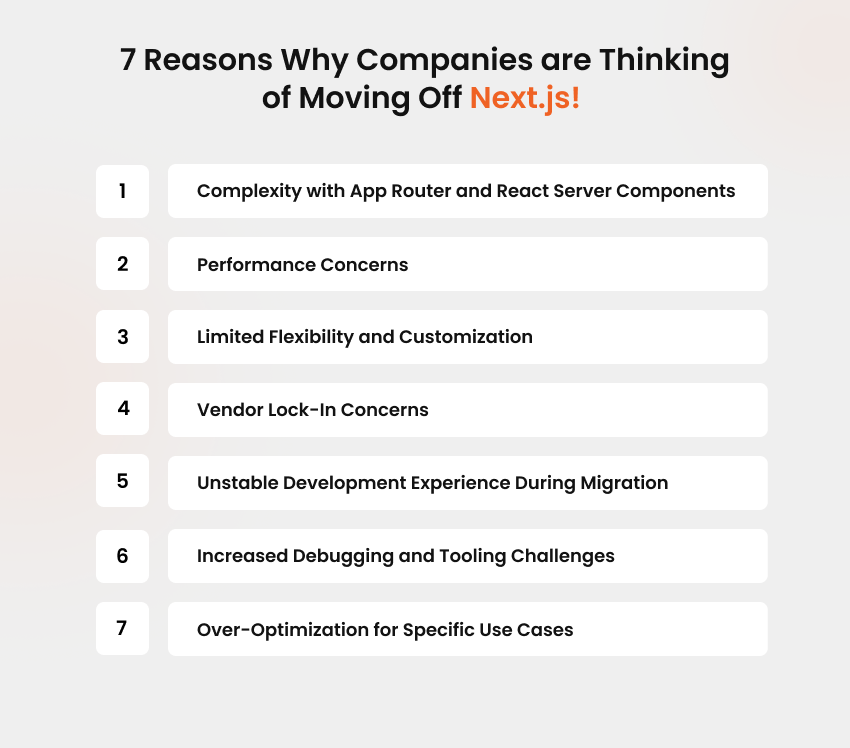
1. Complexity with App Router and React Server Components
The introduction of the App Router and React Server Components (RSC) in Next.js aimed to enhance performance and developer experience. However, these features have become Next.js vulnerabilities because of their complexity, and many developers find them genuinely challenging in practice.
The App Router’s handling of server and client components can lead to confusion, especially when dealing with navigation and data fetching. Additionally, the mental model required to effectively use RSCs differs significantly from traditional React practices, leading to a steeper learning curve — and in 2026, steeper than ever as more teams attempt mid-project migrations.
If you need expert hands to navigate these complexities, you can hire Next.js developers who understand both the App Router and the older Pages Router deeply.
Hire Dedicated Next.js Developers
2. Performance Concerns
Despite Next.js’s reputation for performance, many developers have reported Next.js issues with development server speed and build times throughout 2025–2026. The integration of new features like RSCs and the App Router has, in some cases, led to slower builds and increased memory usage.
Developers have noted that the development server can become sluggish, requiring frequent restarts due to memory leaks — a pattern that directly hits productivity on large codebases.
As per GitHub issue tracking, dynamic routes in App Router are reportedly 4x slower to load than those in the older Pages Router.
For teams who need full understanding of how these rendering models affect performance, our guide on server-side rendering in React breaks down SSR, SSG, and hybrid approaches in detail.
3. Limited Flexibility and Customization
Next.js provides a set of conventions and built-in features that streamline development. However, these conventions can sometimes limit flexibility, making it challenging to implement custom configurations or workflows.
For companies with unique requirements or those needing fine-grained control over their applications, this Next.js vulnerability can be a real hindrance. Customizing routing, data fetching, or build processes often requires workarounds that add maintenance overhead rather than reducing it.
Teams evaluating their options often weigh Next.js against other full-stack development frameworks to find the right fit for their infrastructure and workflow.
4. Vendor Lock-In Concerns
Next.js is developed and maintained by Vercel, and while it’s open-source, many developers express concerns about problems with Next.js’s potential for vendor lock-in. Features like Image Optimization and Middleware are tightly integrated with Vercel’s platform, which can make migrating to other hosting providers more complex.
This tight coupling may deter companies seeking to maintain flexibility in their infrastructure choices — a concern amplified in 2026 as teams plan for long-term platform independence.
5. Unstable Development Experience During Migration
Companies that began adopting the new App Router and RSC model mid-project often report a disjointed developer experience. Many teams find themselves working with both the old Pages Router and the new App Router simultaneously, creating inconsistencies in routing logic, layout handling, and data-fetching methods.

This hybrid state makes it harder to onboard new developers or maintain code consistency, especially in larger teams. The difference between Next.js and React.js becomes even more pronounced during these transitions, as developers must juggle both paradigms at once.
6. Increased Debugging and Tooling Challenges
The abstraction and complexity introduced by RSCs and server/client boundaries pose serious challenges for debugging and observability. Standard browser dev tools often fall short in offering meaningful stack traces or a clear separation of server vs. client components.
Additionally, many popular monitoring and logging tools still lack deep integration with the latest Next.js features. This disconnect can slow down bug fixing and result in longer QA cycles, increasing the overall cost of development.
7. Over-Optimization for Specific Use Cases
In 2026, the community conversation has escalated further. A widely shared Reddit thread titled “Framework Panic: Why Is Everyone Leaving Next.js?” in r/nextjs summarized exactly this frustration — developers feeling that Next.js is increasingly a Vercel-first product rather than a community-first framework. The thread saw hundreds of engineers sharing migration stories toward Remix, Astro, and SvelteKit, with the common theme being a desire to reclaim infrastructure control and development simplicity.
This has nudged companies toward agnostic frameworks like Remix, Astro, and SvelteKit, which emphasize developer freedom and adaptability. Teams exploring these options often start by comparing approaches — understanding how React.js fits into the broader JavaScript ecosystem helps clarify which direction makes sense for their stack.
Conclusion
Next.js remains a powerful tool for building React applications, and its features continue to evolve. However, heading into 2026, the growing chorus of concerns around complexity, performance, vendor lock-in, and debugging challenges means more engineering teams are seriously evaluating their options.
Whether you choose to stay on Next.js, migrate to an alternative, or adopt a hybrid approach, the most important thing is making an informed decision based on your team’s actual needs — not framework hype.
If you are looking to hire a dedicated developer or a professional tech partner who can help you understand whether Next.js is the right fit or whether another framework better serves your goals, Enstacked has got you covered.
Book a Free Consultation Today
Frequently Asked Questions (FAQs)
What alternatives are companies choosing instead of Next.js?
Many companies that have moved off Next.js or are considering it are choosing frameworks like Remix, Astro, Vite, and SvelteKit. These alternatives offer better flexibility, simpler mental models, and often faster development experiences, which address some of the Next.js issues raised by the community.
Is it expensive to migrate from Next.js to another framework?
Migration cost depends heavily on your codebase size and how deeply integrated Next.js-specific features like ISR, Middleware, or Image Optimization are in your app. Smaller projects can migrate in days; larger, App Router-heavy codebases may take weeks. Working with experienced developers helps reduce risk and timeline significantly.
Does moving away from Next.js improve application flexibility?
Yes, many developers find that moving away helps. The problem with Next.js often lies in its opinionated structure and Vercel-specific optimizations. Alternatives like Remix or Astro allow more control over routing, server-side logic, and infrastructure decisions, improving app flexibility.
Is server cost a major reason for dropping Next.js?
Definitely. With features like Incremental Static Regeneration (ISR), dynamic server functions, and middleware, hosting costs for complex Next.js apps can spike, especially on non-Vercel platforms. Server costs combined with Next.js vulnerabilities around performance have been a major factor in why companies are moving away from Next.js in 2026.

- Recover Lost Sales
- Boost Conversions
- Reduce Abandonment
- Faster Store
📘 FREE REPORT
The Shopify Revenue Leaks Report
Discover the hidden mistakes silently costing Shopify stores thousands every month—and learn exactly how to fix them.
Instant access • No spam • Unsubscribe anytime.