





Introduction
Most B2B teams have the same problem.
The leads are coming in, but the lead conversations are a hell of a task. In fact, 79% of marketing leads never convert to sales.
You might want to blame the market, but the problem lies within timing.
Businesses are struggling to target the right customers at the right time. This is the major gap, and this is one of the gaps that Salesforce Pardot is bridging.
Pardot Salesforce is a Pardot B2B marketing automation tool that helps you understand:
- What your prospects are actually doing.
- Who is opening your emails?
- Who is visiting your website?
- Who is quietly researching your product but not ready to talk yet?
With Pardot B2B marketing, you do not chase every lead. Pardot marketing automation automatically nurtures prospects with the right content and shows your sales team which ones are ready for a real conversation.
Let’s keep reading to know more about what pardot b2b marketing automation is and how to increase sales with it.
What is Salesforce Pardot Marketing Automation Platform?
Salesforce Pardot marketing automation is a B2B marketing tool that helps businesses attract the right leads, nurture them over time, and pass sales-ready prospects to the sales team.
Pardot helps marketing and sales work together.
It tracks how potential customers interact with your brand and uses that data to understand who is interested and how interested they are.
In short, Salesforce Pardot marketing automation helps B2B teams stop chasing cold leads and start focusing on prospects who are genuinely ready to talk, making the entire sales process smoother and more effective.
Pardot marketing automation syncs well with Salesforce and helps connect marketing data with sales activity, which is valuable for B2B marketing automation workflows.
Shopify Product Team consistently emphasizes that apps should solve specific problems, not be installed for features alone.
The best merchants are intentional about the apps they install. Every app should have a clear purpose and measurable impact on performance or customer experience.
How Salesforce Pardot Works for B2B Marketing Automation and Improves Sales?
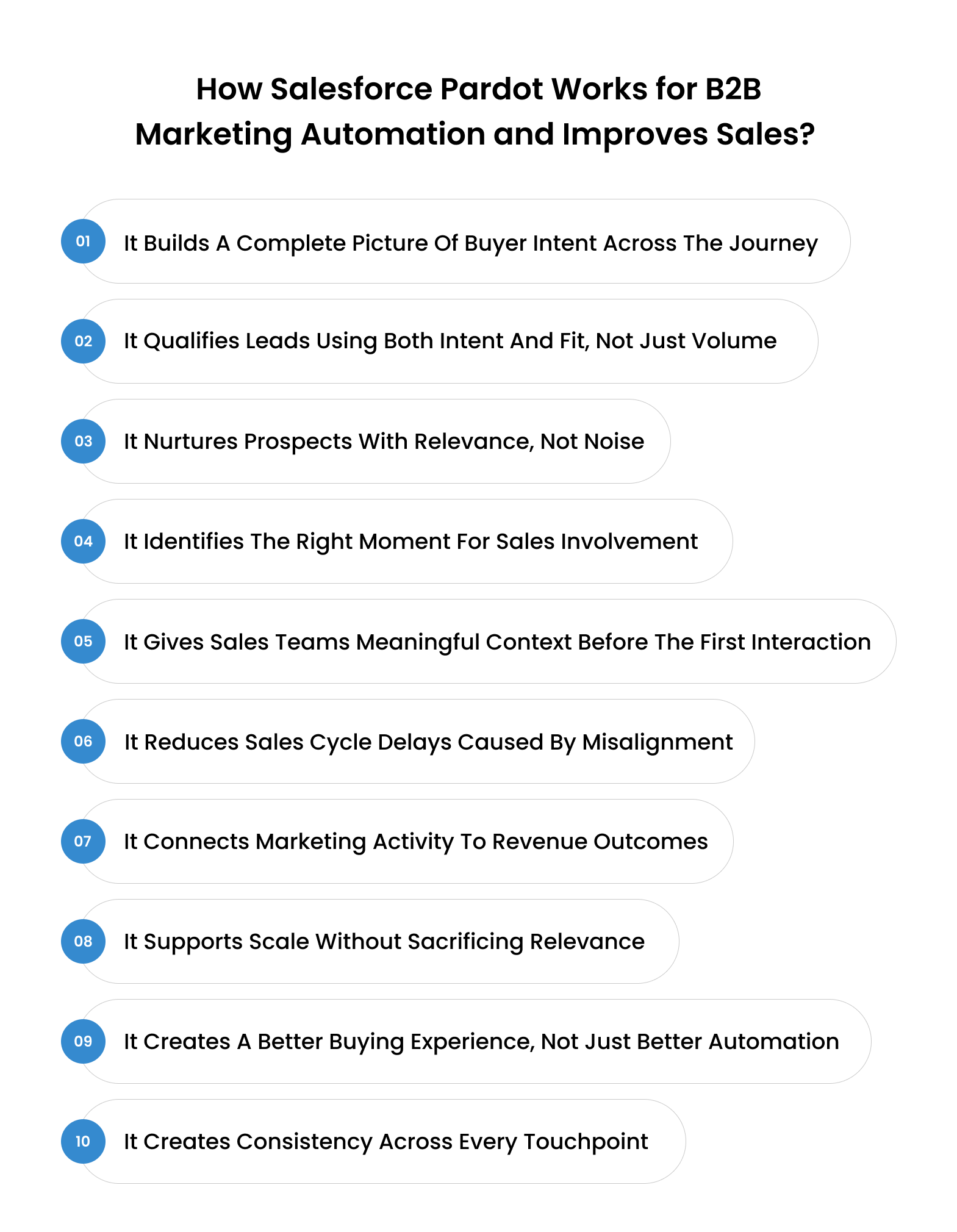
1. It builds a complete picture of buyer intent across the journey
B2B buyers do not move in straight lines. They explore, pause, return, and compare before ever speaking to sales.
Salesforce Pardot works by continuously tracking how prospects interact with your brand across channels. This includes email engagement, website visits, content downloads, event registrations, and form submissions.
This makes intent visible. When someone revisits key pages, engages with multiple emails, or consumes deeper content, Pardot picks that up.
Instead of relying on guesswork, teams can clearly see:
- Who is just browsing
- Who is actively researching
- Who is likely ready for a conversation
This clarity alone removes a lot of friction between marketing and sales.
Read More: HubSpot vs Salesforce for B2B Sales: U.S. Companies Should Use
2. It qualifies leads using both intent and fit, not just volume
One of the biggest reasons sales teams lose trust in marketing leads is poor qualification. High lead volume without context slows sales and wastes effort.
Salesforce Pardot b2b marketing automation addresses this by separating interest from fit.
- Lead scoring measures how engaged a prospect is based on behavior
- Lead grading measures how closely a prospect matches your ideal customer profile
This dual qualification model ensures that a highly active but poorly matched lead does not get prioritized over a quieter but better-fit account.
For example, a junior employee downloading content repeatedly may score high but grade low, while a decision-maker from a target account with moderate engagement may deserve faster sales attention. Pardot marketing automation tool surfaces this difference clearly inside Salesforce
A leading UK commercial company used Salesforce Pardot & got 17,650% ROI and £5.18 M in revenue.
Bruntwood, a leading UK commercial property company, used pardot b2b marketing automation to breathe new life into thousands of dormant leads. By building highly personalized email journeys and automating follow-up based on prospect behavior, they re-engaged cold contacts and drove significant revenue, achieving a reported 17,650% ROI and £5.18 M in revenue from the campaign.
3. It nurtures prospects with relevance, not noise
Most B2B prospects are not ready to buy when they first engage. Pushing sales messages too early creates friction and disengagement.
Pardot solves this through automated lead nurturing that adapts to buyer behavior and stage. Instead of one-off campaigns, it enables structured journeys that deliver relevant content based on what the prospect has already shown interest in.
Effective nurturing typically focuses on:
- Educating prospects rather than selling immediately
- Addressing objections early through content
- Gradually introducing product value as intent increases
Because Pardot Salesforce reacts to engagement signals, prospects do not receive generic emails. Someone reading technical documentation receives different follow-ups than someone exploring high-level solution pages.
This approach builds trust before sales ever enter the conversation.
4. It identifies the right moment for sales involvement
Reaching out too early wastes effort. Reaching out too late loses momentum.
Salesforce Pardot marketing automation continuously evaluates engagement patterns to determine when a prospect is moving from passive research to active consideration. This includes repeat visits to key pages, deeper content consumption, and increased email interaction over a short period of time.
Instead of relying on static rules or manual checks, Salesforce pardit signals sales readiness through actual buying behavior.
This allows sales teams to engage when:
- The prospect has enough context to have a meaningful conversation
- Interest has moved beyond awareness
- The likelihood of response is highest
This timing improves response rates and reduces the friction that comes from poorly timed outreach.
5. It gives sales teams meaningful context before the first interaction
Sales conversations often fail when they start without context.
Pardot b2b marketing automation syncs every engagement touchpoint into Salesforce. Sales teams can see which emails prospects opened, what content they consumed, and which topics caught their attention. This context allows reps to start conversations around real interests instead of asking basic questions.
When sales leads with relevance, prospects feel understood.
This context shifts sales conversations from generic discovery to informed discussion. Instead of asking broad questions, sales can focus on areas the prospect has already shown interest in.
The result is a more relevant first interaction that respects the buyer’s time and builds credibility early in the relationship.
6. It reduces sales cycle delays caused by misalignment
Many B2B deals slow down because marketing and sales operate on different signals.
Marketing nurtures leads based on engagement. Sales rechecks interest from scratch. Prospects receive repeated or misaligned messages. Momentum drops.
Pardot Salesforce keeps both teams aligned around the same intent data. Marketing knows when a lead is ready. Sales trusts the handoff.
This alignment reduces unnecessary back and forth, keeps messaging consistent, and helps deals move forward without friction.
7. It connects marketing activity to revenue outcomes
One of the hardest challenges in B2B marketing is understanding which efforts actually drive revenue.
Salesforce pardot b2b marketing automation tracks how campaigns, emails, and content influence opportunities once they enter the sales pipeline. This allows teams to see which activities contribute to real deals, not just engagement metrics.
Over time, this insight helps organizations:
- Refine messaging based on what converts
- Invest more confidently in high-impact campaigns
- Reduce spending on activities that do not influence sales
This level of visibility turns marketing automation into a revenue-supporting function rather than a lead-generation silo.
8. It supports scale without sacrificing relevance
As lead volume grows, maintaining relevance becomes harder.
Pardot Salesforce handles repetitive qualification and follow-up automatically, while messaging remains tied to real engagement signals. This allows teams to scale their outreach without relying on generic campaigns or manual processes.
The automation works in the background, while the buyer experience stays consistent and personalized. Sales receives fewer but better-prepared leads, and prospects receive communication that aligns with their stage and intent.
9. It creates a better buying experience, not just better automation
B2B buyers pay attention to how brands communicate.
Pardot marketing automation tool helps teams deliver communication that feels timely and relevant instead of repetitive or pushy. Prospects receive fewer but more meaningful messages that align with their interests and stage.
This experience builds confidence. Buyers feel guided rather than sold to. By the time sales engage, trust already exists, which makes decisions easier and conversions more likely.
10. It creates consistency across every touchpoint
Inconsistent messaging confuses buyers and slows decisions.
Salesforce pardot b2b marketing automation platform keeps communication aligned across emails, campaigns, and follow-ups. Marketing and sales work from the same messaging and data, so prospects receive a clear, consistent experience throughout their journey.
This consistency builds confidence. Buyers understand the value faster, trust the brand more, and move through the sales process with fewer doubts.
To Wrap!
B2B marketing works best when it respects how buyers actually make decisions, and Salesforce Pardot does exactly that.
When teams use Pardot B2B marketing automation the right way, they stop chasing leads and start building momentum.
- Sales talks to the right people at the right time.
- Marketing focuses on what truly influences revenue.
The result is a smoother buying journey and stronger conversions.
If you are exploring Salesforce B2B marketing automation and want to implement it in a way that genuinely supports sales, the approach matters as much as the platform. As a dedicated Salesforce partner, Enstacked works closely with B2B teams to design, implement, and optimize Pardot marketing automation based on real business goals.
To know more about Enstacked and how we can help you, book a free consultation with our Salesforce experts.
Read More: Salesforce Implementation Cost (2026): Save 40% Cost
Frequently Asked Questions(FAQs)
Yes. Salesforce Pardot B2B marketing automation works well for growing B2B teams that need structured lead management, longer sales cycles, and tighter marketing–sales alignment. It scales as lead volume and deal complexity increase.
Most teams start seeing improvements in lead quality and engagement within a few weeks. Meaningful sales impact typically appears once Pardot B2B marketing aligns with real buyer journeys and sales feedback.
Unlike many tools, Pardot Salesforce focuses deeply on B2B sales alignment and native CRM integration. This makes Salesforce B2B marketing automation a stronger fit for complex sales cycles and enterprise use cases.
Teams with long sales cycles, multiple decision-makers, and high-value deals benefit the most. Pardot marketing automation works especially well for SaaS, enterprise services, and B2B technology companies.
Basic training helps sales teams interpret engagement data and intent signals correctly. When sales understands Pardot Salesforce insights, follow-ups become more relevant and effective.
The most common mistake is automating without a strategy. Pardot B2B marketing automation delivers results only when workflows reflect real buyer behavior and sales processes.

