
Introduction
You’re getting the traffic. But where are the leads?
You’re running campaigns, publishing content, maybe even ranking on Google. People are landing on your site. But the demo requests aren’t coming in. The contact forms sit quietly. And the pipeline stays thin.
So what’s going wrong?
More often than not, it’s not about getting more people to your site. It’s about what happens after they arrive. That’s exactly what B2B conversion rate optimization is about: figuring out why visitors leave without taking action, and fixing it.
In 2025, average B2B website conversion rates fall around 1.8%. It means around 98.2% of people who find you, people who could genuinely be your next customer, are leaving without ever raising their hand.
The good news is that small improvements here can have a significant impact on revenue. And, all you need is your existing website to work harder, and you need to make the most out of your current traffic.
Let’s dig in to find out about what conversion rate optimization is for B2B, the strategies that work, the tools worth using, and the trends shaping how businesses are approaching it in 2026.
What is B2B Conversion Rate Optimization?

At its core, B2B conversion rate optimization is the process of getting more value out of the website traffic you already have by making it easier for the right visitors to take the next step.
That next step looks different depending on your business.
- It could be filling out a contact form,
- booking a demo,
- downloading a whitepaper,
- or signing up for a free trial.
Whatever action moves a visitor closer to becoming a customer is your conversion. And CRO is the work of making that happen more often.
Now, the B2B part matters a lot here. Optimizing a B2B website is a very different challenge compared to an e-commerce store or a consumer app. In B2C, you’re often convincing one person to make a quick purchase. In B2B, you’re typically dealing with longer sales cycles, multiple stakeholders, higher-stakes decisions, and buyers who do a lot of research before they ever talk to your sales team.
This is why generic CRO advice often falls flat for B2B companies. The playbook has to match the reality of how B2B buyers actually behave.
What is a Good B2B Conversion Rate?
A good conversion rate for a SaaS company looks very different from a good conversion rate for a legal services firm. Comparing the two doesn’t tell you much. What actually matters is how you stack up against businesses in your own space and whether you’re improving over time.
That said, having a general baseline is still a useful starting point. The median B2B conversion rate across all industries sits at 2.9%, based on an analysis of over 100 million data points. Most B2B companies typically see marketing conversion rates somewhere in the 2–5% range.
Why CRO Matters for B2B Businesses?
Most B2B companies pour the majority of their budget into getting people to their website, ads, SEO, content, and events. But very little attention goes toward what happens once those people actually arrive.
Visitors arrive, look around, and leave. No form filled. No demo booked. No conversation started.
That’s not a traffic problem. That’s a conversion problem.
Companies spend roughly $92 acquiring a new customer for every $1 they invest in converting them. That gap is enormous, and it’s where a lot of revenue quietly leaks away.
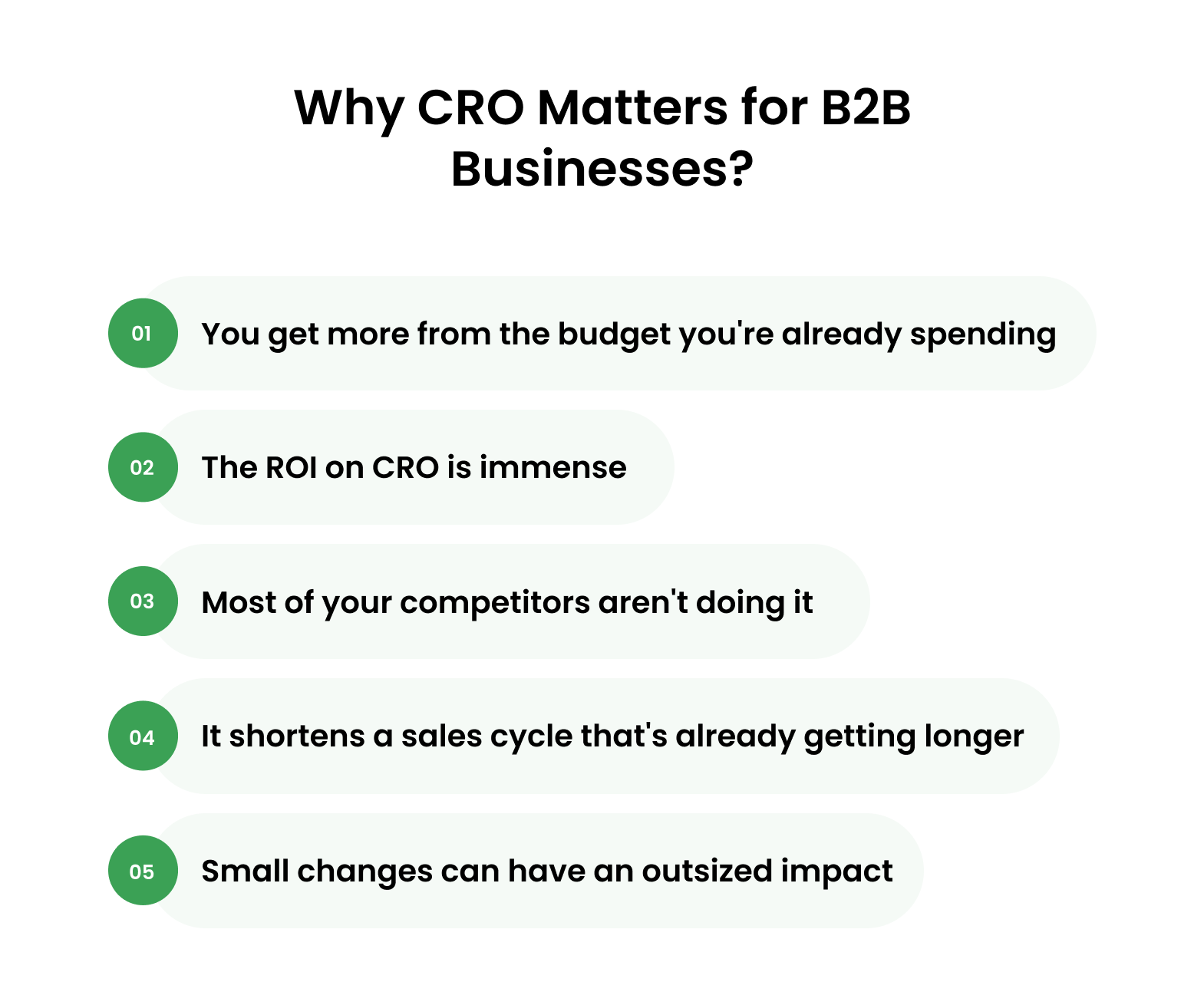
Here’s why putting more focus on conversion rate optimization for B2B is one of the smartest moves a growing business can make:
1. You get more from the budget you're already spending
Every dollar you spend on ads or SEO is bringing people to your site. CRO is about making sure that investment doesn’t go to waste. Even a one-point improvement in your B2B website conversion rate, say, moving from 2% to 3%, can reduce your customer acquisition cost by 15 to 25%. That’s a meaningful saving without increasing your marketing spend by a single rupee.
2. The ROI on CRO is immense
Companies that invest in CRO tools and structured programs report an average return on investment of 223%. That’s not a small improvement; that’s a significant shift in how efficiently a business turns website visitors into actual revenue.
Also Read: How Shopify CRO actually improves ROI?
3. Most of your competitors aren't doing it
Only 39.6% of B2B companies have a documented CRO strategy in place. Which means if you’re willing to put in the work, you’re already ahead of the majority of businesses in your space, and that gap tends to compound over time.
4. It shortens a sales cycle that's already getting longer
B2B sales cycles aren’t getting any shorter. Sales cycles have lengthened by 32% with enterprise deals stretching even further. When your website is optimized with the right content, clear next steps, and a frictionless experience, it does a lot of the heavy lifting before a prospect ever speaks to your sales team. That means faster decisions and shorter cycles.
5. Small changes can have an outsized impact
CRO doesn’t always require a full website redesign. Sometimes the smallest fixes move the needle the most. Reducing the number of form fields from 7 to 3 can increase conversions by 20 to 35% without increasing the ad spend.
Landing pages with a single CTA convert 32% better than those with two or more. And adding live chat to your website can increase demo requests by 20%. So, there are so many small changes that you can make over time, that might not take drastic changes, but can create a big impact.
B2B Conversion Rate Optimization Strategies
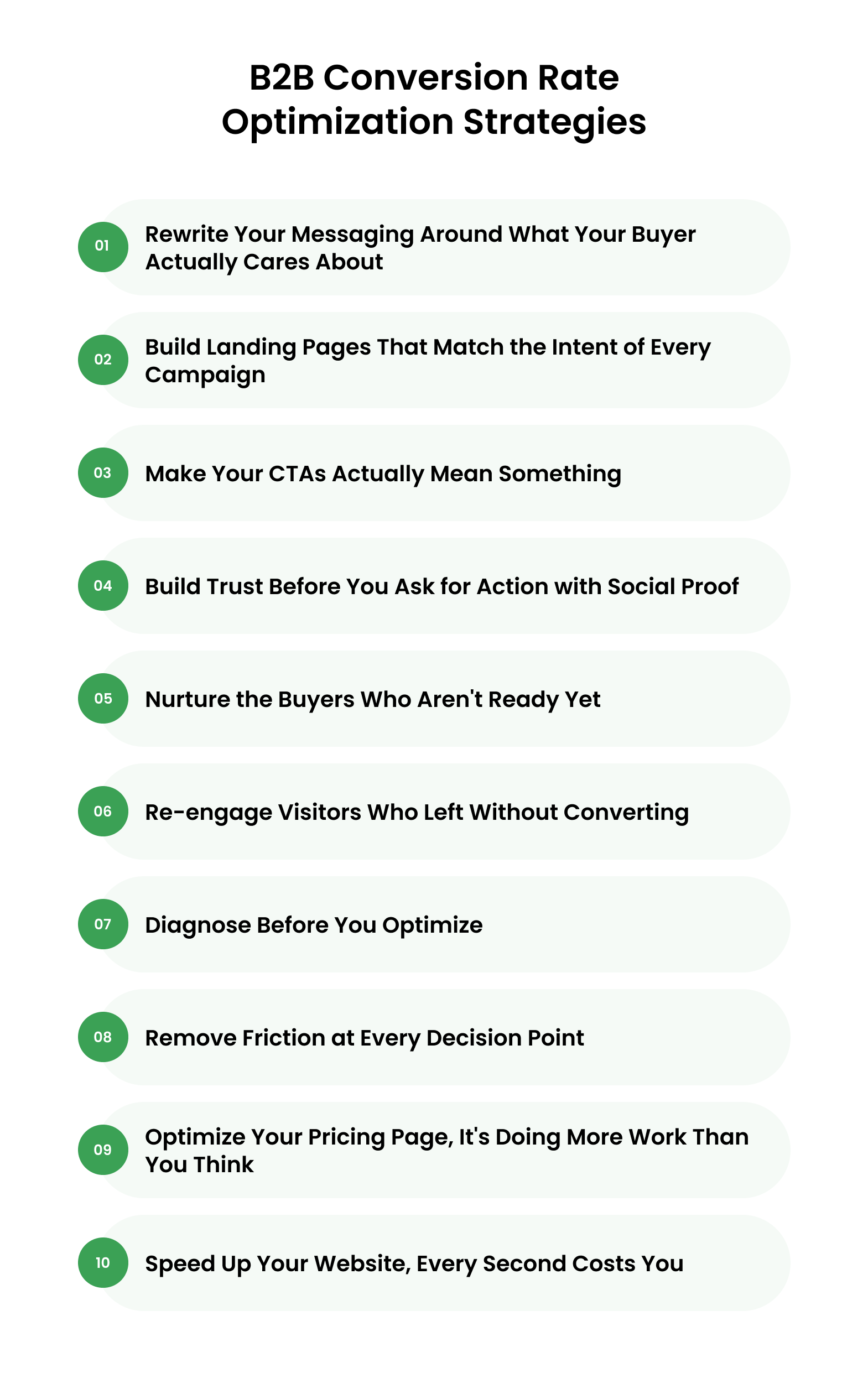
Here’s the thing about CRO: it’s not about making your website look better. It’s about making it work harder. Every strategy below is something you can actually take action on, and each one is directly tied to getting more of the right people to take the next step with your business.
1. Rewrite Your Messaging Around What Your Buyer Actually Cares About
Most B2B websites talk about what a product is rather than what it does for the buyer. The result? Visitors read the page, don’t see themselves in it, and leave.
The fix is simple: shift your messaging from features to outcomes.
Instead, we provide AI-powered analytics solutions, so you know exactly where your pipeline is leaking, before your quarter ends. Talk directly to your buyer’s pain points and show them how you’ll make their life easier. Add bold, measurable claims, but always back them up with proof.
Expert Tip from Enstacked: Go through your last 10 closed-won deals and ask, what problem were they actually trying to solve when they found us? Use that exact language on your homepage. It’s often completely different from what’s currently written there.
2. Build Landing Pages That Match the Intent of Every Campaign
Sending paid traffic to your homepage is one of the most common and costly mistakes in B2B marketing. Your homepage is built for everyone. But a landing page is built for someone specific with one message, one offer, and one clear action.
Landing pages focus attention, eliminate distractions, and deliver the exact information a lead needs to take the next step. Match the headline to the ad they clicked. Curate the simple, conversational flow. And, focus on the single action you want them to take, that is impossible to miss.
3. Make Your CTAs Actually Mean Something
Submit. Learn More. Get Started. These aren’t calls to action, they’re placeholders. They tell the visitor nothing about what happens next or what they’ll get out of it.
A strong CTA is specific, outcome-focused, and written from the buyer’s perspective. Get my free demo beats submit button every single time. See how much you could save outperforms Contact us. The more clearly your CTA communicates what the visitor gets, not what they have to do, the more likely they are to click it.
4. Build Trust Before You Ask for Action with Social Proof
Trust is the single biggest barrier to conversion in B2B. A visitor who doesn’t trust you enough won’t fill out your form, no matter how good your product is. The way you build trust isn’t by saying you’re great, it’s by showing evidence that others have already taken the leap and benefited from it.
The key is placing that proof strategically, not buried at the bottom of your homepage, but right next to the moments where a visitor is most likely to hesitate. A case study result near your demo CTA. A client logo next to your pricing. A specific testimonial on the page where someone is deciding whether to get in touch.
Semrush does this well; they don’t just assert credibility through text, they back it up with compelling statistics about the number of companies, including Fortune 500 firms, that trust their platform.
5. Nurture the Buyers Who Aren't Ready Yet
In B2B, the majority of visitors who land on your site are not ready to buy today. They’re researching, comparing, building a case internally. If your website only caters to the 3% who are ready to act right now, you’re ignoring the other 97%.
Think about what prospects want most at each stage. Are they looking for information about a product, or do they want to see testimonials that will convince them to buy? Give early-stage visitors something valuable, a guide, a calculator, a comparison resource in exchange for their email. Then nurture them with content that moves them closer to a decision over time.
The businesses that win in B2B aren’t always the ones with the best product. They’re often the ones who stayed in front of the right buyers longest.
6. You Want Built-In Payment Processing
Most visitors won’t convert on their first visit and that’s completely normal in B2B. What matters is whether you have a way to bring them back. Target people who visited high-intent pages, like pricing or demo request pages, but didn’t complete the action.
Follow up with personalized emails or retargeting ads with relevant content, case studies, or product demos that address their specific pain points and encourage them to take the next step.
A well-structured retargeting campaign doesn’t feel intrusive when the content is relevant. It feels like a helpful reminder at exactly the right moment.
7. Diagnose Before You Optimize
A lot of businesses run A/B tests without properly diagnosing the problem first. They test a new headline on a page that has a navigation issue, driving everyone away and wonder why nothing changes.
- Use session recordings to see where visitors drop off.
- Use heatmaps to understand what people actually pay attention to.
- Look at which pages have high traffic but low engagement.
Only once you understand why something isn’t working should you start testing fixes.
8. Remove Friction at Every Decision Point
Every unnecessary step between a visitor’s interest and their action is a potential exit. B2B sales cycles are already 25% longer than they were five years ago; your website shouldn’t be adding to that by making it harder than it needs to be for someone to take the next step.
Friction looks different at each stage.
- At the top of the funnel, it might be content that’s hard to find.
- In the middle, it might be a form with too many fields.
- At the bottom, it might be only offering one rigid path to take action when a buyer might prefer a softer first step.
The businesses that grow fastest aren’t always the ones with the most sophisticated websites. They’re often just the ones that have made it the easiest to say yes.
9. Optimize Your Pricing Page, It's Doing More Work Than You Think
Most B2B businesses treat their pricing page as an afterthought. In reality, it’s often the highest-intent page on the entire website, as it is the place where buyers go to make a final decision. If it’s confusing, vague, or asks more questions than it answers, you’re losing deals at the finish line.
A well-optimized pricing page does three things clearly:
- It shows what’s included at each tier,
- It helps the visitor self-select the right option,
- and it removes the fear of making the wrong decision.
Your pricing page, treated as a dedicated conversion page rather than just a table of numbers, should be one of the most carefully optimized pages on your site.
Quick-Tip from Team Enstacked: Add a FAQ section that addresses the most common objections. Put a testimonial or case study right on the page. Make it easy to talk to someone if a visitor isn’t sure which option is right for them.
10. Speed Up Your Website, Every Second Costs You
This one doesn’t get enough attention in B2B, possibly because the focus is always on messaging and design. But page speed has a direct and measurable impact on conversions.
A one-second delay in load time can reduce conversions by 7%. For a website generating 50 leads a month, that’s potentially 3–4 leads disappearing every single month, not because your offer wasn’t good enough, but because the page took too long to load.
So, run your website through Google’s PageSpeed Insights and make sure your speed is upto standards. Look at your largest images, your third-party scripts, and your hosting setup. These are usually where the biggest gains are hiding, and they’re often fixable without a full website overhaul.
Final Thoughts
CRO isn’t a one-time project you hand off and forget about. It’s an ongoing commitment to understanding your buyers better, removing the things that get in their way, and making it easier for the right people to say yes.
The good news is that you don’t need to fix everything at once. The businesses that see the best results from CRO aren’t the ones that overhaul their entire website overnight; they’re the ones that pick the right problems to solve first, test their way to answers, and keep improving from there.
And that’s really what B2B conversion rate optimization is about. Not chasing a benchmark number. Not running tests for the sake of running tests. But building a website that does justice to the product you’ve built and the buyers you’re trying to serve.
If you’re not sure where to start or want a clearer picture of what’s holding your conversions back, the team at Enstacked can help you with a free CRO Audit of your site. We check your website across different parameters & get back to you with a detailed report. Book a free audit today.
Frequently Asked Questions(FAQs)
Some changes, like improving page speed or simplifying a form, can show results within weeks. Bigger strategic shifts typically take 2–3 months before the data becomes meaningful. Start with high-impact, low-effort fixes first while building toward longer-term improvements in parallel.
In B2C, you’re convincing one person to make a quick, low-risk purchase. In B2B, you’re dealing with multiple stakeholders, longer evaluation periods, and higher-stakes decisions. B2B CRO focuses less on impulse triggers and more on clarity, trust-building, and guiding buyers through a longer journey.
It depends on what you need.
- For session recordings and behavioral analytics, use Hotjar or Microsoft Clarity.
- For A/B testing. Optimizely or VWO.
- For AI-powered personalization built specifically for B2B, Mutiny.
- For predictive lead scoring and account-based targeting, use 6sense or Demandbase.
Jumping straight into testing without diagnosing the real problem first. Running A/B tests without a clear hypothesis rooted in actual data almost always produces inconclusive results. A proper conversion audit should always come before optimization.
Not at all. Some of the highest-impact CRO improvements cost nothing, rewriting your homepage messaging, removing unnecessary form fields, repositioning your social proof, or improving your CTA copy. Budget becomes more relevant when you start investing in dedicated tools or running large-scale personalization programs.
Start where the drop-offs are biggest. Look at your analytics and identify pages with high traffic but low engagement or conversion. Your pricing page, demo request page, and primary landing pages are almost always worth prioritizing; these are the pages where buyers are closest to making a decision.

