
Introduction
The latest version, Node.js v25.4.0, was officially released on January 19, and it is one of those releases that quietly changes how serious teams think about performance, startup speed, and production readiness.
This is not a flashy release packed with breaking changes. Instead, it is a maturity milestone. Several features that developers have been testing cautiously are now stable, reliable, and ready for real production workloads.
If you maintain large Node applications or run services where startup time and debugging reliability matter, this update deserves your attention.
Let’s break down what makes Node.js 25.4.0, the current Node.js version, an important upgrade.
Rafael Gonzaga, Principal Open Source Engineer and active voice in the Node.js release process, highlighted the stabilization of major features in Node.js v25.4.0. His release announcement specifically calls out the stabilization of require(esm), the module compile cache, and several debugging/profiling tools being marked as stable, all significant confidence builders for developer adoption.
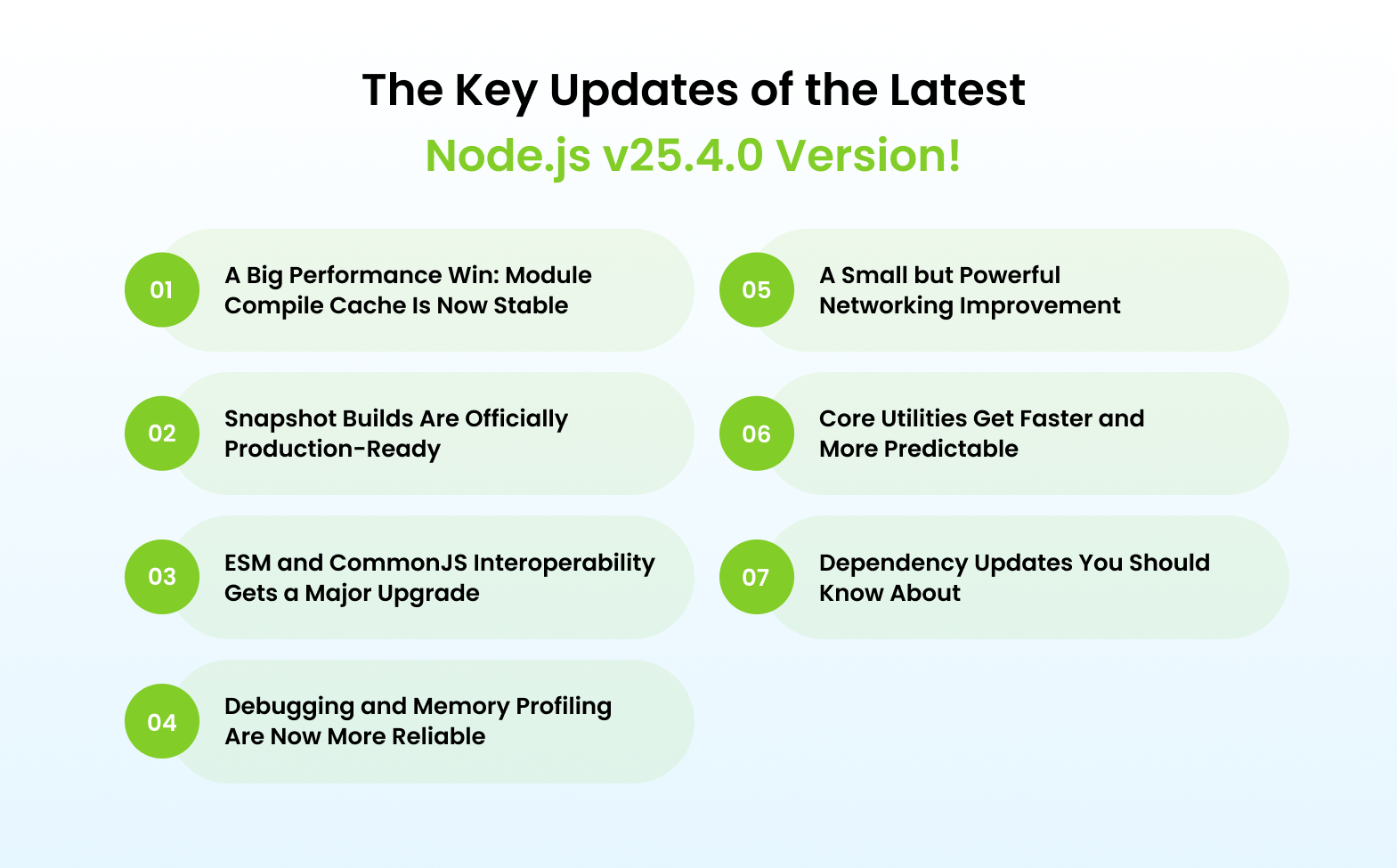
The Key Updates of the Latest Node.js v25.4.0 Version!
1. A Big Performance Win: Module Compile Cache Is Now Stable
The headline feature in Node.js v25.4.0 is the stabilization of the module compile cache.
Until now, this capability lived in experimental territory. Developers could test it, but few were comfortable relying on it in production. That changes with this release.
The module compile cache allows Node.js to pre-compile modules ahead of time, reducing the repeated parsing and compilation work that normally happens during startup. For small projects, the difference may be subtle. For large codebases with hundreds or thousands of modules, the impact is immediate.
What this means in practice:
- Faster application startup
- Reduced initialization overhead
- Better performance consistency in serverless and containerized environments
If you have ever watched a Node service slowly spin up under load, this feature directly targets that pain point.
2. Snapshot Builds Are Officially Production-Ready
Alongside the compile cache, Node.js 25.4.0 marks the following CLI options as stable:
      --build-snapshot
--build-snapshot-config
These tools let you create pre-compiled runtime snapshots that bundle application state and compiled code into a single startup artifact. When used together with the compile cache, they enable extremely fast boot times.
This is especially valuable for:
- Serverless platforms
- Short-lived workers
- Edge and high-throughput services
The key takeaway is confidence. These features are no longer experimental. Teams can adopt them without worrying about sudden API changes or removal in future versions.
3. ESM and CommonJS Interoperability Gets a Major Upgrade
One of the longest-running friction points in the Node ecosystem has been mixing ES Modules and CommonJS.
In Node.js v25.4.0, the ability to require(esm) is now officially stable. This significantly simplifies working in mixed module environments.
Why this matters:
- You can integrate modern ES Modules into existing CommonJS projects more cleanly
- Incremental migrations become far less painful
- Shared libraries can support both formats with fewer workarounds
In addition, Node.js now supports subpath imports starting with a hash, such as #/. This gives developers more flexibility when defining and referencing internal package paths.
Together, these changes make module boundaries clearer and reduce the cognitive load of managing multiple module systems in one codebase.
Reddit contributors have discussed the technical and ecosystem challenges around requiring ESM modules, often highlighting how earlier support was experimental and developers had to work around limitations. The stabilization of module interoperability in Node.js v25.4.0 directly aligns with these long-standing community discussions.
4. Debugging and Memory Profiling Are Now More Reliable
This release also delivers solid improvements for developers who spend time diagnosing memory and performance issues.
Two important tools have graduated from experimental status:
      --heapsnapshot-near-heap-limit
v8.queryObjects()
The heap snapshot option automatically captures a snapshot when memory usage approaches a defined limit. This is invaluable for tracking down memory leaks before your process crashes.
The v8.queryObjects() method gives deeper insight into objects living in memory at runtime, making advanced debugging sessions far more effective.
5. A Small but Powerful Networking Improvement
Enterprise developers will appreciate a subtle but impactful addition in Node.js 25.4.0:
http.setGlobalProxyFromEnv()
This new function allows Node.js to read proxy settings directly from environment variables and apply them globally. No more manual proxy wiring inside application code.
This is especially useful in:
- Corporate networks
- Restricted environments
- CI and internal infrastructure setups
It is a small quality-of-life change that removes the friction many teams deal with daily.
6. Core Utilities Get Faster and More Predictable
The util module also received attention in this release. A new helper, convertProcessSignalToExitCode, makes it easier to translate process termination signals into consistent exit codes.
Additionally, internal assertion and comparison utilities were optimized for speed and correctness, including fixes around deep comparisons involving invalid dates.
These are not headline features, but they contribute to a more stable and performant core runtime.
7. Dependency Updates You Should Know About
As part of this release, Node.js updates several bundled dependencies:
- npm upgraded to version 11.7.0
- Crypto root certificates updated to NSS 3.117
These updates improve security, compatibility, and package management reliability across environments.
Should You Upgrade to the Latest Node.js Version?
If you are running performance-sensitive applications, managing large codebases, or preparing for future-proof module architecture, Node.js 25.4.0 is a strong upgrade candidate.
This release is not about experimental ideas. It is about turning proven features into stable foundations that teams can confidently build on.
You can download and test Node.js latest version today. Node.js 25.4.0 is available for Windows, macOS (Intel and Apple Silicon), and major Linux distributions via the official Node.js website.
If you are looking for professional assistance to download and find out whether you should go for the Latest Node.js version or not, then connect with our team at Enstacked.
We have a team of Node.js developers, who can help you make the right decision and get started.
Frequently Asked Questions(FAQs)
Node.js v25.4.0 is part of the Current Node.js latest version line, not the Long Term Support release. It is well-suited for teams that want early access to stable performance and tooling improvements, but long-term production systems that require extended support may still prefer an LTS version.
The latest Node.js version includes newer performance optimizations and developer tooling that are not yet available in LTS. However, LTS versions prioritize long-term stability and extended maintenance.
Yes. Node.js v25.4.0 maintains compatibility with popular frameworks such as Express, NestJS, Fastify, and Koa. Most applications will run without changes, though it is always recommended to test dependencies against the current Node.js latest version before deploying.
In most cases, no major pipeline changes are required. However, teams adopting newer performance features or snapshot tooling may want to update their build scripts to take advantage of startup optimizations available in the latest Node.js version.
Yes. This release is particularly attractive for serverless and edge workloads due to its focus on startup speed, runtime efficiency, and predictable debugging behavior. Faster initialization can directly improve cold-start performance in these environments.
Node.js v25.4.0 does not introduce major breaking changes compared to earlier Node 25 releases. Most updates focus on stability and reliability rather than altering existing APIs. Standard regression testing is still recommended before upgrading.
As a Current release, Node.js v25.4.0 will receive updates for a shorter lifecycle compared to LTS versions. Developers planning long-term deployments should monitor the Node.js release schedule to plan future upgrades.
The official Node.js website is the recommended source for downloading Node.js v25.4.0 installers and binaries. It provides builds for Windows, macOS, and Linux, along with verification details and documentation.